
Let’s Not Reinvent the Wheel: A Tool to Recruit and Retain Top Public Health Talent
ResourcesAuthor: Dany J. Zemmel, MPH, Training and Engagement Senior Manager, Region V Public Health Training Center
Public-facing job postings and detailed internal job descriptions are critical tools for recruiting and retaining top talent in governmental public health agencies. However, job descriptions often remain outdated for decades, lacking accurate details around duties, responsibilities, and knowledge, skills, and abilities for an individual to perform a given role effectively.
The shorter job postings that an agency’s HR department shares, that recruiters use, or that get posted on job boards are often lackluster, not fulfilling the intended purpose of attracting high-quality candidates for a position.
The Public Health Model Job Descriptions Project, referred to as Model 2.0 throughout this blog, is a free resource for any state, territorial, local, or Tribal agency to use when building a more robust workforce to improve population health.
About the Public Health Model Job Descriptions Project
Aspects from a 2024 Model Job Description set developed by the Public Health Management Corporation were integrated into the Model 1.0 set, creating an updated, merged framework.
The Region V Public Health Training Center and the University of Minnesota Center for Public Health Systems developed Model 2.0 in 2022 in partnership with Heather Krasna. Model 2.0 contains 30 unique roles, including six newly developed roles and additional details for all roles.
- Roles cover frontline and supervisory positions, as well as independent specialists.
- Each role’s description contains up-to-date information on qualifications, certifications, knowledge, skills, abilities, and duties.
- Each accompanying posting contains language aiming to attract potential candidates to the position.
- The freely available Model 2.0 contains 30 distinct job descriptions and postings, an updated user guide, and a new brief overview video.
| Roles in Public Health Model Job Descriptions 2.0 | ||||
|---|---|---|---|---|
| Administrative Assistant | Deputy Director | Financial Specialist^ | Informatics Specialist | Public Health Accreditation Specialist |
| Call Center Team Lead^ | Disease Intervention Specialist | Grants Manager | Laboratory Scientist | Public Health Director |
| Community Health Worker | Environmental Engineer | Health Educator | Logistics/ Maintenance Coordinator^ | Public Health Nurse |
| Communications Specialist | Environmental Health Specialist | Health Equity Coordinator | Mental Health Counselor | Public Health Planner |
| Data Analyst | Emergency Preparedness Director | Health or Medical Assistant | Nutritionist or Dietician* | Public Health Program Manager |
| Dentist* | Epidemiologist | Human Resources Specialist | Policy Analyst | Social Worker* |
| ^New roles from the Public Health Management Corporation set. | ||||
| *Entirely new roles in Model 2.0. | ||||
Using Model 2.0 to Strengthen Recruitment and Retention
While Model 2.0 is not mapped to any competency set or Public Health Accreditation Board standards and measures, an agency can modify these materials to align to preferred competencies based on needs and priorities, such as hiring or professional development processes.
An agency’s HR or civil service department must ensure that descriptions and postings match its own job analysis of the position, listing the essential functions of the role. The templates are not meant to replace those efforts, nor should they be construed as representing HR compliance guidelines; they are intended to serve as a starting point and can be a vital resource for an agency’s HR and/or hiring team.
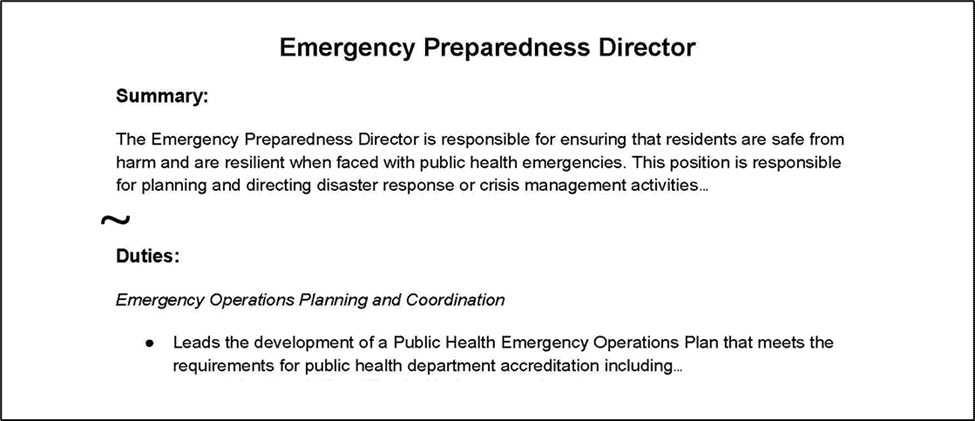
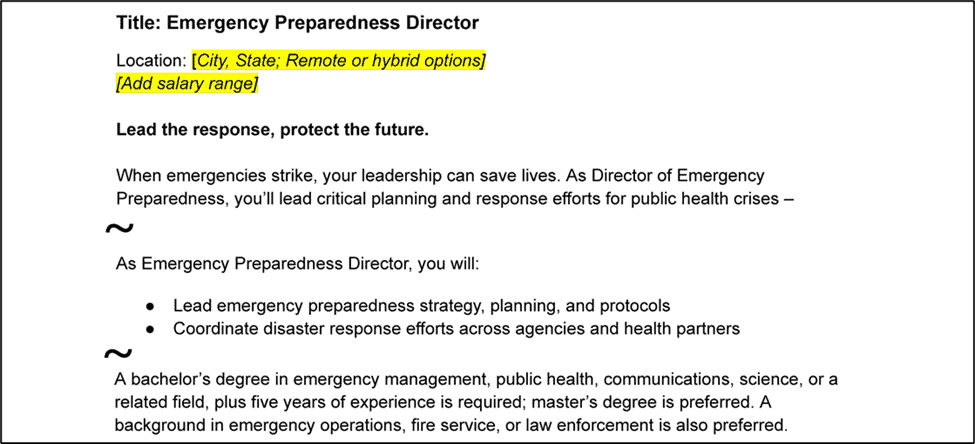
By using Model 2.0, an agency can ensure the right individuals apply for positions, perform effectively and efficiently in new roles, grow professionally with the appropriate support from the agency, and remain within the agency over the long term.
As an additional resource, a recruitment toolkit further guides the seven key steps of the recruiting cycle:
- Identify hiring needs
- Write job descriptions
- Build recruitment pipelines and advertise jobs
- Select candidates
- Onboarding and retention
- Assess and evaluate
- Advocate for more funding and a better recruiting system.
Securing top talent in governmental public health agencies is critical to ensuring we can continue to improve health outcomes in the populations we serve.
Acknowledgements
Existing job descriptions, literature reviews, job task analyses, and input from practitioners in governmental health agencies, public health workforce researchers, and representatives from the Association of State and Territorial Health Officials and the New York State Association of County Health Officials informed the development of the Public Health Model Job Descriptions Project.
The project team also extends its thanks to the following individuals and organizations for their contributions to the development of Model 2.0:
- Kimberly Green-Warren, MPH, SMART Health Education, LLC
- Heather Krasna, PhD, MS, EdM, Columbia University School of Public Health
- National Network of Public Health Institutes
- Public Health Management Corporation
This work is supported by funds made available from the Centers for Disease Control and Prevention (CDC) of the U.S. Department of Health and Human Services (HHS), National Center for STLT Public Health Infrastructure and Workforce, through OE22-2203: Strengthening U.S. Public Health Infrastructure, Workforce, and Data Systems grant. The contents are those of the author(s) and do not necessarily represent the official views of, nor an endorsement, by CDC/HHS, or the U.S. Government.
The Region V Public Health Training Center is supported by the Health Resources and Services Administration (HRSA) of the U.S. Department of Health and Human Services (HHS) under grant number UB6HP31684 Public Health Training Centers ($970,593). This information or content and conclusions are those of the author and should not be construed as the official position or policy of, nor should any endorsements be inferred by Region V PHTC, HRSA, HHS or the U.S. Government.